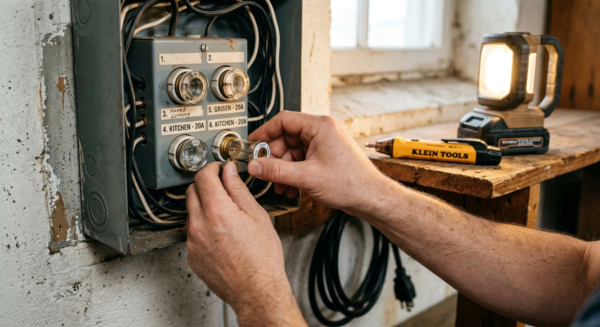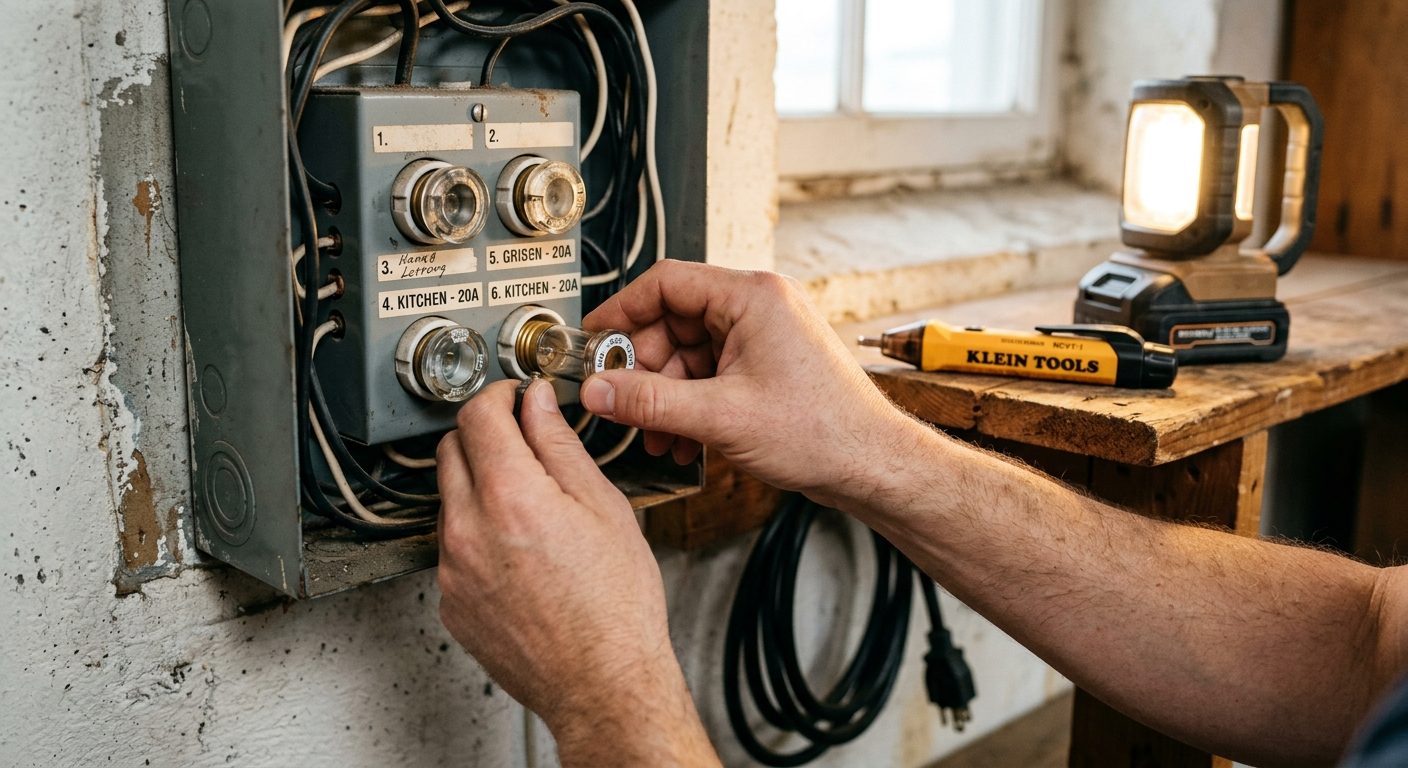
Knowing how to fix a blown fuse starts with finding out why it opened. Replace it only with a fuse of the correct amperage and type. A careful homeowner can often replace an ordinary screw-in branch-circuit fuse. However, repeated failures, panel damage, main fuses, and cartridge fuses require a licensed electrician.
A fuse is a one-time safety device. You cannot reset or repair it. Its internal metal element melts when current exceeds the fuse rating, which stops the circuit wiring from overheating. Never install a higher-amperage fuse to prevent future failures because it can allow wiring inside the walls to overheat.
Likely Causes of a Blown Fuse
A blown fuse usually points to an overloaded circuit, short circuit, ground fault, or faulty appliance. Before replacing it, note what was running and which lights or outlets lost power. This information can help you separate a one-time overload from a wiring problem.
A fuse that opens immediately often indicates a serious fault. Do not install several replacement fuses to test an unknown problem. Repeated fault current can damage the fuse holder and connected equipment. If you see smoke, scorching, melted insulation, or arcing, stay away from the panel and call an electrician.
Overloaded Circuit
An overload occurs when working devices draw more current than the circuit can safely carry. Portable heaters, window air conditioners, hair dryers, microwaves, toasters, and power tools draw substantial power. Running several of them on one circuit can open the fuse.
The fuse usually opens while several appliances are operating. Those appliances may work normally when used separately on suitable circuits. Reducing the load can prevent another failure, but it does not increase the circuit’s capacity. If normal household use causes frequent overloads, ask an electrician whether the home needs additional circuits.
Short Circuit or Ground Fault
A short circuit occurs when energized conductors make an unintended, low-resistance connection. A ground fault sends current through grounded metal, equipment, or another path to ground. Either fault can create a sudden current surge and open the fuse immediately.
Warning signs include a sharp pop, flash, burned odor, or discoloration around an outlet or fixture. The fuse may also blow as soon as you operate a switch. Possible causes include damaged cords, loose receptacles, pinched wires, wet outdoor equipment, and failed fixtures.
Do not remove outlet covers or open fixtures while the circuit remains energized. Finding concealed wiring faults requires proper training and test equipment. Leave that work to a licensed electrician.
Faulty Appliance or Device
An appliance with damaged wiring, a failed heating element, or a failing motor can blow a fuse. A likely clue is that the circuit works until you plug in or start one specific appliance. Unplug that device and stop using it.
Inspect only the accessible cord and plug. Look for cuts, crushed sections, loose blades, discoloration, or heat damage. Do not move the appliance to another circuit to see whether it blows a second fuse. Have a qualified technician repair it, or replace it.
Safety Checks Before Opening the Fuse Panel
Fuse panels commonly appear in older electrical systems. Some contain worn parts or unsafe changes made by previous owners. Work only with dry hands, a dry floor, and battery-powered lighting. Turn off and unplug every load on the affected circuit before approaching the panel.
Switch off the main disconnect only if you can identify and operate it safely. It should feel secure and show no heat, moisture, buzzing, or visible damage. Check the affected receptacles and fixtures with a non-contact voltage tester. Test the tester on a known live source before and after each check.
Turning off the main disconnect does not de-energize the incoming service conductors. Some parts inside the panel may remain live. Never remove the panel cover, reach behind fuse holders, or touch conductors. A non-contact tester also does not make internal panel work safe for an untrained person.
Wear safety glasses and remove rings, watches, and other conductive jewelry. Stand to the side when operating a disconnect. Never use pliers, screwdrivers, foil, coins, or improvised objects in a fuse socket.
Stop if you find exposed conductors, missing covers, rust, water, loose parts, or melted material. Call an electrician if you cannot identify and isolate the circuit confidently.
Tools and Replacement Fuse
This job requires little equipment, but the replacement fuse must match the circuit. Read the full label on the old fuse rather than relying on its size or color. Match the amperage and fuse type, including any time-delay or rejection-base design.
Do not remove or defeat a Type S adapter. The adapter prevents someone from installing an oversized fuse. If the label is unreadable or the existing fuse appears incorrect, do not guess. An electrician can determine the proper fuse from the wiring, connected load, panel listing, and circuit configuration.
- Replacement fuse with the correct, identical amperage and type
- Non-contact voltage tester
- Flashlight or battery-powered work light
- Safety glasses
- Dry cloth for gripping an intact screw-in fuse, if needed
- Multimeter with continuity mode, optional for testing a removed fuse
How to Fix a Blown Fuse Safely
This procedure covers an intact, accessible screw-in branch-circuit fuse that feels cool. It does not cover damaged fuse holders, panel wiring, service equipment, pullout blocks, or large cartridge fuses. Those components may expose dangerous energized contacts.
Call an electrician if the fuse has shattered, melted into the socket, or left part of its base behind. Do not try to extract it. A successful replacement restores power without heat, noise, odor, smoke, or another failure.
- Identify the affected circuit. Check which lights, outlets, and fixed appliances lost power. Compare them with the panel directory, but do not rely only on an old handwritten label.
- Turn off and unplug all circuit loads. Switch off lights and unplug portable appliances in the affected area. Pay particular attention to heaters, air conditioners, cooking appliances, and power tools.
- Shut off the accessible main disconnect. Operate it only if it looks dry, secure, and undamaged. Check the affected outlets and fixtures with a non-contact voltage tester. Verify the tester on a known live source before and after the check.
- Inspect the panel without taking it apart. Look for a broken fuse window, melted material, scorching, corrosion, loose sockets, or water. Continue only if the problem appears limited to an intact screw-in fuse.
- Remove the suspected fuse. Grip the insulated glass or ceramic body and turn it counterclockwise. Keep your fingers away from the socket and do not rock the fuse. Stop if it sticks, cracks, or pulls another panel part loose.
- Check whether the fuse has opened. A visible gap or melted section in the element often confirms the failure. Some fuse bodies hide the element, so visual inspection may not work.
- Test continuity if necessary. Place the removed fuse on a dry, nonconductive surface. Follow the multimeter manufacturer’s continuity-testing instructions. Never use resistance or continuity mode on an energized circuit.
- Match the replacement fuse. Confirm the correct amperage, type, time-delay rating, and base design. Never substitute a higher-amperage fuse or bypass a Type S rejection feature.
- Install the new fuse. Thread it clockwise into the socket using finger pressure only. Stop when it sits straight and feels snug. Do not force it, cross-thread it, or tighten it with a tool.
- Restore power while the loads remain off. Stand to the side and turn the main disconnect on. Watch and listen without touching the panel. Shut the power off if you notice buzzing, crackling, flashing, smoke, odor, or unusual warmth.
- Reconnect loads one at a time. Start with a light or one small device, then add the remaining loads gradually. Stop if the new fuse opens or any warning sign appears.
Troubleshooting After Fuse Replacement
A replacement fuse restores circuit protection, but it does not correct the original overload or fault. Pay attention to when the new fuse opens. The timing often helps identify the source.
An immediate failure with all portable loads disconnected suggests damaged wiring or faulty hardwired equipment. A failure linked to one appliance points toward that appliance or its cord. If the fuse lasts until several devices run together, the circuit probably has an overload. Keep the fuse rating unchanged in every case.
-
Problem: The new fuse blows immediately with everything unplugged.
Likely cause: The circuit may have a short, ground fault, damaged receptacle, failed switch, or faulty hardwired equipment.
Action: Leave the circuit off and call a licensed electrician. -
Problem: The fuse blows when one appliance starts.
Likely cause: The appliance, plug, cord, motor, or heating element may have failed.
Action: Unplug the appliance and arrange repair or replacement. Do not test it repeatedly on other circuits. -
Problem: The fuse blows only when several appliances run together.
Likely cause: Their combined current exceeds the circuit’s safe capacity.
Action: Reduce simultaneous use. Ask an electrician about additional circuits if normal routines keep causing overloads. -
Problem: The fuse sits crooked or will not screw in easily.
Likely cause: The socket may have damaged threads, corrosion, heat damage, or an incompatible fuse design.
Action: Do not force the fuse. Leave the circuit off and have an electrician inspect the holder. -
Problem: Power remains off even though the fuse tests good.
Likely cause: An upstream fuse may have opened, a disconnect may remain off, or a connection may have failed. The utility may also have an outage.
Action: Check only accessible disconnect positions and nearby circuits. Then contact an electrician or the utility. -
Problem: The fuse or surrounding panel feels warm, buzzes, or smells burned.
Likely cause: A loose or deteriorated contact may be creating resistance and heat.
Action: Shut off power only if you can do so safely. Stay clear and arrange urgent electrical service.
Preventing Another Blown Fuse
After restoring power, list the lights, receptacles, and appliances controlled by the fuse. This record can help you avoid placing several high-demand appliances on one circuit. It also gives an electrician useful diagnostic information if the problem returns.
Plug high-demand portable appliances directly into suitable wall receptacles. Do not use lightweight extension cords or power strips as permanent wiring. Replace damaged cords, and stop using receptacles that feel loose or show cracks, discoloration, or heat damage.
Never install an oversized fuse, fuse substitute, or adapter that defeats the panel’s rejection feature. If the home lacks enough circuit capacity, arrange an electrical evaluation. New wiring or additional circuits provide the proper solution.
New circuits and wiring often require permits and inspections. Local rules may also require a licensed electrician. Check with your local building department before planning that work.
A fuse panel is not automatically unsafe because it uses fuses. Its condition, capacity, and previous modifications matter more. Keep the area dry, accessible, and clear of stored items. Store only correctly matched spare fuses nearby, with each amperage and type clearly separated.
When to Call a Licensed Electrician
A single blown plug fuse from an obvious, corrected overload may allow a straightforward replacement. However, damaged panel parts, repeated failures, concealed wiring faults, and service equipment require professional work. Main fuses, cartridge fuses, and pullout blocks need particular caution.
Never remove the panel cover to tighten a socket, replace a holder, or inspect wiring. Incoming service components may remain energized even with the main disconnect off. If you remain unsure how to fix a blown fuse without touching panel wiring, stop and call a licensed electrician.
- The replacement fuse blows again, especially immediately.
- The panel buzzes, crackles, sparks, smokes, or smells burned.
- A fuse socket looks loose, blackened, corroded, melted, or unusually warm.
- The fuse has broken, stuck in its socket, or lost part of its base.
- You find water, heavy rust, or dampness around the panel.
- You discover foil, coins, bypass devices, oversized fuses, or improper adapters.
- The failure involves a main fuse, cartridge fuse, pullout block, feeder, or service equipment.
- Power remains off after you install an intact, correctly matched fuse.
- A switch, outlet, fixture, cord, or appliance shows scorching or melted insulation.
- Normal household use repeatedly overloads the circuit.
- You cannot identify the correct fuse amperage and type.
- The repair requires removing the panel cover, touching conductors, adding wiring, or installing a circuit.